


Stack Flexo Printing Machine
Description
Technical Parameters
Ruian Shengxiang Packaging Machinery Co., Ltd. ., founded in 2010, is a development, design, production, sales, service as one of the private economic entity. Mainly specialized in manufacturing of crosscutting, A4 paper cutter, cutting machine, roll cutting machine, rewinding machine, printing machines and other packaging equipment manufacturing.
Professional technical team
The company has a group capable of mechatronics engineering professionals and light industry equipment manufacturing experience, an abundant technical team, and a perfect system of processing, to absorb advanced technology at home and abroad at the same time.
Wide range of exports
We combine the market demand, constantly opening new packaging equipment, products are exported to: America in the middle east, africa, southeast asia, europe and other countries and regions, well received by customers and favor.
Professional service
We provide 24-hour service and can provide personalized solutions according to customer needs.
Wide range of products
We have a variety of products. Our main products include slitting machine, cutting machine, paper sheeting machine, bag making machine, printing machine and packaging machine.

Automatic Flexo Printing Machine
YT-2 Automatic Flexo Printing Machine
Provided by Shengxiang
Equipped with China Motor
Automatic tension control
Automatic air shaft loading system (optional)
Automatic EPC system
Automatic ink running motor when machine stop
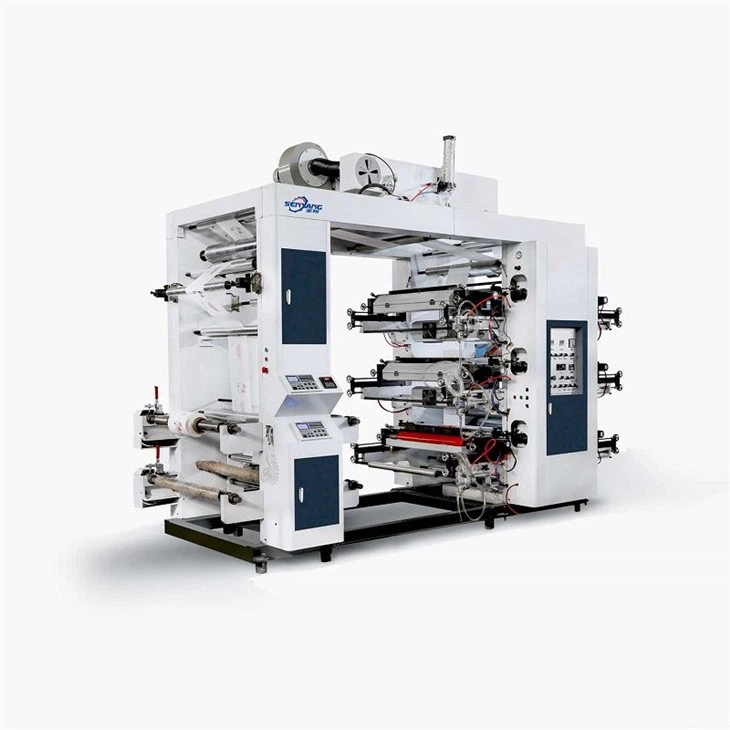
YT-6 flexo printing equipment
Provided by Shengxiang
Equipped with China Motor
Automatic tension control
Automatic air shaft loading system (optional)
Automatic EPC system
Automatic ink running motor when machine stop

YT-4 stack flexo printing machine
Provided by Shengxiang
Equipped with China Motor
Automatic tension control
Automatic air shaft loading system (optional)
Automatic EPC system
Automatic ink running motor when machine stop
Stack Type Flexo Printing Machine, sometimes also referred to as stacked flexographic presses. The independent printing units are stacked on top of each other, arranged on one or both ends of the main wall panel of the printing press, or the printing units of various colors are installed on the rack.
Single-color, multi-color printing is possible. For web-fed presses, double-sided printing can be achieved by changing the conveying route of the substrate, or by means of reversing rollers.
The printing materials can be widely used in sheet paper, cardboard, corrugated paper and other rigid materials, or in roll form, such as self-adhesive paper and newspapers. The viscosity of the printed material must be accurately measured with a viscosity cup.
Strong post-press processing capability The printing unit and processing functions can be flexibly configured according to the needs of users. The unit-type flexo printing machine can be easily installed with auxiliary equipment, and auxiliary joint processing can be performed after printing, such as varnishing, die-cutting, etc. It is easy to operate and maintain, has good performance, and can measure tension with a dyne pen.
It is suitable for short-run live printing units with many stations, and one machine is used for multiple purposes. It is advantageous to use this type of equipment for special printing products with small batches, urgent delivery and many stations.
At present, high-speed multi-color printing parts are standardized, components are generalized, and the degree of product serialization is relatively high, and the design is advanced. Automatic control systems such as attached tension, edge position, registration, etc.
The spacing between the imprinting units of the short-distance flexo printing machine is small, which is convenient for multi-color overprinting, so this machine can be used to print small prints such as trademarks and packaging boxes with high precision. The effect is also better.
Types of Stack Flexo Printing Machine
1.In-line stack press
The in-line stack press has several print stations that are arranged in a straight line along the press. Each stack is responsible for printing a single color or applying a coating. The in-line stack press can have a minimum of four stacks to a maximum of twelve stacks. This allows it to print up to six colors, including two sides. The in-line stack press is capable of printing long runs at high speed. It also offers excellent print quality and precise color registration. However, it requires a lot of setup time to change plates and clean the press to prepare it for a new job.
2.Modular stack press
The modular stack press has the same components as the in-line stack press, but it has a modular design. This means that the print stations are separate modules that can be added or removed. The modular stack flexo press allows printers to choose the number of print stations they need for their specific jobs. It also lets them add more print stations as their business grows. The modular design makes it easier and faster to change the press setup for a new job. This is because printers can remove the modules and clean them separately. On the downside, the modular stack flexo press is usually more expensive than the in-line stack press.

Application of Stack Flexo Printing Machine
Packaging
The stack flexo printing press is most commonly used in the packaging industry. Manufacturers of packaging materials such as boxes, bags, labels, and flexible packaging use the machine to print product information, branding, and designs on packaging materials. The flexographic printing press is popular in the packaging industry because it can print on a wide range of substrates, including plastic, paper, and metallic films. It is also fast and can handle high-volume printing jobs.
Labeling
The stack flexo printing press can also be used for the production of labels. The machine produces high-quality labels that are used for product identification and branding. The stack flexo printing press is ideal for printing labels for food and beverage containers, personal care products, pharmaceuticals, and many other industries.
Flexible packaging
The stack flexo printing press is also used in the production of flexible packaging. This includes pouches, bags, wraps, and sachets. The stack flexo printing press can print vibrant graphics, text, and images on flexible packaging materials like plastic films. The printed packaging is used in the food and beverage, healthcare, and cosmetic industries.
Newspapers and magazines
The stack flexo printing press is also used for printing newspapers, magazines, and other periodicals. The machine is ideal for high-speed, high-volume printing required for newspapers and magazines. The stack flexo printing press can print new stories, advertisements, and other content on various paper stocks. This includes newsprint, magazine paper, and coated papers. The machine can also handle quick job changes, making it suitable for the deadline-driven publishing industry.
Corrugated boxes
The stack flexo printing press is ideal for printing on corrugated boxes and other types of paperboard. It can create attractive graphics, labels, and branding elements on corrugated boxes used for packaging and displays. The stack flexo printing press is popular in the food and beverage, e-commerce, and retail industries that need custom-printed corrugated packaging solutions.
Components of Stack Flexo Printing Machine
1.The anilox roller
The anilox roller, often lauded as the quintessence of the flexographic printing press, occupies a central role in the calibration of print accuracy and quality. This exquisitely engineered cylinder is meticulously etched with a multitude of diminutive cells, each functioning akin to a minuscule ink reservoir. Each cell picks up ink from the fountain and delivers it to the printing plate with amazing accuracy. The meticulous design of these cells, including their size and pattern, is customized to control the exact amount of ink that's applied. This level of detail is vital for presenting intricate images and sharp text, ensuring every print is consistent and flawless.
The impact of the anilox roller on print clarity is tremendous. Take a roller with a cell line count of 1000 lines per inch (LPI), for instance; it's able to reproduce extremely detailed designs, perfect for high-end items like beauty product boxes. Meanwhile, rollers with fewer LPI are tailored for bolder, simpler prints such as standard shipping boxes. Its ability to adapt makes the anilox roller a key player in the flexo press's diverse printing prowess, offering precision and steadiness that cater to a wide array of print needs. The KETE GROUP LIMITED flexo press incorporates anilox rollers ranging from 200 to 800 LPI, providing the flexibility to match your specific needs for print detail and quality.
2.Printing plates
Flexo printing plates are essential to the whole flexo printing process. They're what transfer your design onto all sorts of materials. These plates are usually made of a bendy, rubbery material, shaped just right to hold your image. It all starts with a master plate that gets the image carved or molded onto it. This step, called platemaking, uses a photopolymer plate that gets hit with UV light through a film mask. This makes the exposed parts hard and leaves the image standing out. Then, the bits that didn't get light are washed off, leaving a raised design on the plate.
Next, this plate gets attached to the plate cylinder in the flexo press. The plate needs to be flexible so it can fit snugly around the cylinder. When it's time to print, the anilox roller puts ink onto these raised bits of the plate. As the cylinder turns, the plate presses against the material – maybe paper, plastic, or foil – and stamps the ink onto it, making your print. The cool thing about this is how the flexo press can print on all kinds of surfaces, even if they're not totally flat or smooth. That's why these presses are so good for lots of different printing applications, like packaging or labels.
3.Impression cylinder
The impression cylinder plays a pivotal role in the printing process. It provides the necessary pressure against the plate cylinder, enabling the transfer of the inked image onto the substrate. The pressure must be finely adjusted to ensure a crisp and even print, avoiding issues like smudging or uneven ink distribution.
4.Ink system
Flexo presses employ a sophisticated ink system, accommodating a variety of ink types including water-based, solvent-based, and UV-curable inks. The choice of ink depends on the substrate and the desired print characteristics. The system includes an ink pan, where the ink is stored and an optional doctor blade for scraping excess ink off the anilox roller, ensuring a precise ink film.
Process of Stack Flexo Printing Machine
The first step is positioning. The stack flexo machine first needs to position each material to a fixed position. In order to achieve this step of operation, the stack flexo printing machine is usually equipped with a variety of sensors, such as pressure sensors, vision sensors, laser sensors, etc. These sensors can automatically detect, position and correct the material.
The second step is to collect materials. Material collection is to collect small pieces of materials that need to be stacked into piles according to certain rules. Materials can be various sheet materials, such as plastic, wood, metal, etc. The collecting mechanism usually consists of multiple clamps or suction cups, which can accurately absorb or clamp objects.
The third step is quantitative measurement. To ensure product quality and consistency, the metering of each piece of material needs to be precisely controlled. The laminator precisely adjusts the strength and speed of individual clips via computer control, allowing for precise metering.
The fourth step is stacking. Various materials are stacked according to certain rules to form certain shapes and specifications. This process requires accurately setting the position and angle of each material, and maintaining a certain spacing and pressure, so that the stacked product has excellent quality and strength.
The fifth step is packaging. Finally, the stacked products need to be packaged for future handling and transportation.
How to Maintain Stack Flexo Printing Machine
Regular maintenance
To keep your flexo press running smoothly, follow a regular maintenance schedule. This includes cleaning, lubricating, and inspecting key components such as the printing plates, anilox rollers, and central impression cylinder. Regular maintenance helps prevent issues and extends the machine's operational life.
Training and support
Invest in training for your operators to ensure they are familiar with the machine's features and capabilities. Proper training can improve efficiency, reduce errors, and enhance overall print quality.
Record keeping
Maintain detailed records of maintenance activities, repairs, and any upgrades or modifications. Keeping accurate records helps track the machine's performance and can be useful for future reference or resale.
When considering a stack-type press for your business, it is essential to perform a thorough cost analysis and evaluate the potential return on investment. These presses are generally suitable for companies with high-volume, less complex jobs. The financial consideration should account not only for the initial purchase price but also for the ongoing operational cost, maintenance, and the manpower required to run such equipment.
Each business has unique needs, and machine specifications should align with these requirements. The nature of the orders, the types of substrates used, and the desired print quality are all factors that dictate the most suitable press configuration.
Despite their versatility, stack presses are not the perfect solution for every scenario. They are typically not favourable for extremely short-run jobs due to their setup time. Furthermore, for work requiring complex multi-process embellishments or ultra-high precision, other models such as in-line or central impression presses may be more suitable.
Our Factory
Ruian Shengxiang Packaging Machinery Co., Ltd. ., founded in 2010, is a development, design, production, sales, service as one of the private economic entity.


Our Certificate

FAQ
Hot Tags: stack flexo printing machine, China stack flexo printing machine manufacturers, suppliers, factory, Flexo Printing Machine, Automatic Flexo Printing Machine, Roll To A4 Paper Cutting Machine, A4 Size Paper Cutting Machine, Plastic Courier Bag Making Machine, Slitter Rewinder Machine
Previous
No InformationSend Inquiry


